Android vs IOS vs Cross-platform development comparison ImproveIT Solutions
Android vs IOS vs Cross-platform development comparison ImproveIT Solutions
In today’s dynamic mobile app market, businesses face a crucial decision: Should you develop a native app or opt for a cross-platform solution? The answer to this question significantly influences the app’s performance, development cost, and user experience across iOS and Android.
Native development provides superior performance and complete access to platform-specific features. On the other hand, cross-platform development offers a faster, more cost-effective approach with a shared codebase across both iOS and Android platforms. So, how do you choose the right path for your app?
In this guide, we’ll explore the benefits and drawbacks of both native and cross-platform app development. By understanding the strengths of each approach, you’ll be better equipped to decide which one aligns with your app’s needs, business goals, and audience.
Let’s break down each option.
1. Cross-Platform App Development
Overview
Cross-platform frameworks like React Native, Flutter, or Xamarin allow you to develop a single app that runs on both iOS and Android using shared code.
Pros
Cost-Effective: You only develop one codebase for both platforms, saving time and money.
Faster Development: Building one app for both platforms reduces overall development time.
Easier Maintenance: Updates and bug fixes are streamlined since changes are applied across platforms.
Consistent UI: Achieve a unified look across devices, with minor platform-specific adjustments.
Cons
Performance Limitations: Cross-platform apps may not match the speed or efficiency of fully native apps, particularly for resource-intensive apps like games.
Limited Access to Native Features: Some features that require platform-specific APIs may not be fully supported.
Customization Challenges: Tailoring the UI/UX to each platform’s unique design can be more complex.
Best Use Cases
Startups or businesses needing a quick, budget-friendly solution for both iOS and Android.
Apps with simple functionality, where platform-specific features aren’t critical.
Projects where a Minimum Viable Product (MVP) is the priority to test the market.
2. Native iOS App Development
Overview
Native iOS apps are built using Swift or Objective-C, designed specifically for Apple devices.
Pros
Superior Performance: Native apps are optimized for the platform, providing better performance and responsiveness.
Full Access to iOS Features: Utilize the latest Apple technologies like ARKit, Face ID, and deep hardware integrations.
Seamless UX: Native apps align with Apple’s design standards, delivering smooth animations and a polished user experience.
App Store Prioritization: Native iOS apps often enjoy better visibility and can attract highly engaged users on the App Store.
Cons
Higher Costs: Developing separate apps for iOS and Android doubles the development effort and cost.
Longer Time to Market: Native iOS apps take longer to develop compared to cross-platform apps.
Best Use Cases
Apps targeting an iOS-first audience or those with higher revenue potential on iOS.
Apps requiring the latest Apple-specific features or hardware.
Businesses focused on creating a high-performance app with flawless user experience on iPhones and iPads.
Native Android apps are developed using Kotlin or Java, tailored specifically for Android devices.
Pros
Performance Optimization: Native Android apps are highly optimized for the Android ecosystem.
Access to Android-Specific Features: Full use of Android-specific tools, like Google Assistant, widgets, and advanced notifications.
Customization Flexibility: Android’s open ecosystem allows more control over system-level features.
Broad Reach: Android holds the largest market share, particularly in emerging regions.
Cons
Device Fragmentation: Developing for Android requires testing across a variety of devices and screen sizes, increasing complexity.
Cost & Time: Similar to iOS, developing a separate Android app can be more costly and time-consuming.
Best Use Cases
Apps targeting regions where Android dominates, such as India, South America, or Africa.
Projects requiring deep integration with Google services or Android-specific hardware.
Businesses focused on performance across a diverse range of Android devices.
When to Choose Each Approach
Go Cross-Platform if:
You need a quick launch for both platforms with a smaller budget.
The app’s complexity is moderate, with limited platform-specific requirements.
You’re building an MVP to validate the market on both iOS and Android.
Go Native iOS if:
iOS is your primary market (e.g., North America, Europe) or your main revenue source.
You want to leverage the latest iOS features for optimal performance.
A polished, seamless UX on Apple devices is your top priority.
Go Native Android if:
Android dominates your target markets.
You need tight integration with Android APIs and Google services.
Your app must run efficiently across a wide variety of Android devices.
Conclusion
Choosing between cross-platform, native iOS, or native Android development depends on your budget, audience, and performance needs. Cross-platform development is an excellent choice for speed and cost-efficiency, while native apps excel when platform-specific features and high performance are critical.
By understanding the advantages and limitations of each approach, you can choose the best development strategy to meet your app’s unique goals.
Need help making the right choice? We’re here to guide you in selecting the best platform based on your specific requirements and to develop the perfect app tailored to your business. Let us help bring your vision to life!
In this article, we explore up-to-date market data and trends surrounding AI adoption in healthcare, and break down the most impactful AI-powered features transforming modern HealthTech applications.
Keywords: Artificial intelligence, Healthcare, AI in Healthcare, Top HealthTech AI features, Generative AI in medicine, HIPAA-compliant AI tools, AI-powered healthcare apps, Predictive analytics in healthtech, Patient care automation, AI for clinical diagnostics, Medical app security.
Why AI in Healthcare Is No Longer Optional
Artificial Intelligence (AI) in healthcare has moved far beyond the conceptual stage – it’s actively reshaping how care is diagnosed, delivered, and managed. Unlike many industries still experimenting with AI, healthcare has long been one of the earliest AI adopters – not out of trend, but out of need. Back in 2017, clinical tools like EyeToAI – one of the first diagnostic support platforms we helped deliver – were already using machine learning to assist physicians, long before AI became a mainstream conversation. Today, the healthcare sector is showcasing AI’s real-world value through measurable improvements in both clinical outcomes and operational efficiency.
Whether it’s enhancing diagnostic precision, optimizing clinical workflows, or elevating the overall patient experience, AI isn’t here to replace medical professionals – it’s here to empower them.
For HealthTech companies, the question is no longer if you should implement AI – but how. Here’s why it matters now more than ever:
1. Explosive Market Growth
The global AI in healthcare market is experiencing explosive growth* – projected to grow at over 38% annually and reach between $110 and $187 billion by 2030. This surge is fueled by rising demand for smarter diagnostics, more efficient care delivery, and data-driven decision-making in medical systems.
* – from $21.66 billion in 2025 to $110.61 billion by 2030, driven by a 38.6% CAGR, according to Grand View Research.
– from USD 26.57 billion in 2024 and is projected to reach USD 187.69 billion by 2030, growing at a CAGR of 38.62% from 2025 to 2030, according to Markets & Markets.
2. Widespread Adoption Among Physicians
In 2024, 66% of physicians reported using AI in healthcare – a 78% increase from 2023, according to an AMA survey. Common uses include documentation, care plans, translation, and assistive diagnosis. Despite some lingering doubts, enthusiasm for AI continues to grow.
3. Healthcare Executive Confidence in Generative AI
According to Bain & Company, 95% of healthcare executives believe that Generative AI will fundamentally transform the industry. Remarkably, 54% are already reporting a meaningful return on investment (ROI) within the first year of implementation – proving that GenAI is moving fast from hype to real healthcare value.
AI in healthcare. Reality Check: Low Implementation Rates?
Despite the undeniable need and game-changing potential of AI in healthcare, only 19% of institutions have successfully implemented it at scale (NIH, 2024).
Does that mean AI isn’t needed in HealthTech? Absolutely not. This gap doesn’t signal a lack of value – it highlights the real challenge: AI implementation must be strategic, effective, and responsible, not driven by hype.
Our Perspective
The challenge is not to adopt AI just because it’s trending – but to implement it thoughtfully.. At ImproveIT Solutions, we believe the future of healthcare doesn’t lie in AI adoption alone, but in smart, purposeful AI integration – where technology elevates human decision-making, not replaces it.
That’s why successful HealthTech products aren’t just AI-powered – they’re feature-smart. The key is identifying the right AI features that actually solve real clinical, operational, and patient challenges.
So, what are the most impactful, in-demand AI features that modern healthcare applications truly need today?
Top 10 AI Features in HealthTech: What Modern Healthcare Apps Really Need
To help HealthTech leaders make smarter AI decisions, ImproveIT Solutions prepared a practical overview of the 10 most impactful AI features driving innovation in healthcare and wellness apps in 2025. Each feature is broken down by its core purpose, direct benefits for patients, clinicians, and administrators, and how to implement it the right way.
It’ll help you to discover how to:
Use predictive analytics to reduce readmissions and anticipate complications
Apply anomaly detection to catch early warning signs in real-time data
Turn clinical notes into structured insights with NLP tools
Increase treatment adherence with personalized AI recommendations
Boost chronic care with remote patient monitoring and telehealth tools
Add AI chatbots and triage assistants for 24/7 patient support
Speed up diagnoses with AI-powered medical image analysis
Save admin time and costs with automation for healthcare back office tasks
Build on HIPAA-ready infrastructure for secure and compliant AI solutions
Prevents readmissions, personalizes care, saves costs
Python, Scikit-learn, AWS HealthLakeTensorFlow
Use patient history & wearable data for early warnings
2. Anomaly Detection
Identifies irregular patterns in health data
Detects early deterioration, device malfunctions
PyOD, Azure ML, GCP Vertex AI
Apply to real-time vitals and EHRs for proactive alerts
3. NLP & Clinical Data Parsing
Turns unstructured notes into structured insights
Saves time, improves documentation accuracy
spaCy, GPT-4, Langchain, Haystack
Fine-tune models on your clinic’s note style
4. Personalized AI Recommendations
Recommends care plans, reminders, actions
Boosts treatment adherence, patient engagement
TensorFlow, PyTorch, AWS Personalize
Combine EHR + user feedback for highest impact
5. Remote Patient Monitoring (RPM)
Tracks vitals, sends alerts to providers
Enables better chronic care and telehealth
BLE, IoMT + Firebase, Google Cloud, Azure IoT
Integrate with wearables for continuous feedback
6. Virtual Assistants & Chatbots
24/7 triage, appointment scheduling, FAQ
Reduces wait times, improves access to care
GPT-4, Rasa, Dialogflow, Microsoft Bot Framework
Layer with symptom checker for triage automation
7. Medical Image Analysis
Identifies patterns in X-rays, MRIs, CT scans
Speeds diagnosis, reduces human error
OpenCV, Keras, Azure Computer Vision, GCP AutoML
Always validate AI outputs with human review
8. Admin Workflow Automation
AI handles claims, billing, EHR data entry
Saves staff time, reduces paperwork errors
UiPath, Power Automate, Zapier, AWS Textract
Start with repetitive low-risk tasks to prove value
9. Compliance & Privacy Tools
Ensures HIPAA/GDPR adherence, audit logs
Builds trust, protects sensitive health data
AWS Shield, Azure Security Center, GCP DLP
Use audit logging and end-to-end encryption by default
10. Real-Time Data Dashboards
Aggregates and visualizes patient or system data
Improves decision-making, engagement
Power BI, Looker, Streamlit, Dash
Focus on clean UI + role-based views (clinicians vs admin)
From predictive analytics and anomaly detection to admin automation and HIPAA-compliant infrastructure, these features support better care, faster diagnostics, and smoother operations – with proven success in top apps worldwide.
Want the Right AI Features in Your Health App?
We help you choose, implement, and scale AI features based on your product’s needs and budget – 📩 let’s talk: [email protected]
How We Deliver: Our Case Studies Across HealthTech & Beyond
One of our recent HealthTech projects for a leading French medical research association focused on a critical challenge: transforming raw data from blood tests into structured insights that could support earlier risk detection and smarter care pathways.
The client came to us with a clear mission:
→ Connect doctors and patients through one centralized platform
→ Run multilingual surveys and manage large volumes of test results
→ Identify potential risk groups for proactive outreach
→ Ensure secure data handling in line with medical compliance standards
What We Delivered:
A fully multilingual platform supporting secure, structured survey data and clinical entries
A smart analytics engine enabling researchers to analyze and interpret patient data at scale
End-to-end development, from architecture to deployment
Transparent estimates and predictable delivery across all milestones
6 engineers onboarded in just 2 weeks
Zero vendor lock-in and minimal third-party dependencies for long-term flexibility
Not Just for Healthcare
A voice recognition system originally developed to streamline patient communication in one of our HealthTech projects we worked with recently inspired a new client – this time from the sales domain.
The real challenge isn’t adopting AI because it’s trending – it’s about implementing it intelligently. Core AI features should be designed to simplify, enhance, and empower human work – with thoughtful integration and a clear understanding of where they truly bring value.
What’s more, many AI capabilities are cross-industry by nature. With the right strategy, they can be easily adapted to different use cases and domains – whether it’s healthcare, education, logistics, or sales. It’s not about the technology itself, but about how and where you apply it to drive real impact.
Final Thoughts: Smart Features = Real Value
At ImproveIT, we partner with HealthTech innovators to deliver more than beautiful UIs – we build clinically relevant, data-smart, and AI-ready healthcare solutions.
We prioritize features based on real user needs, medical workflows, and data availability
We design scalable AI components that are GDPR and HIPAA-compliant
We provide full-cycle development teams or quickly extend your in-house team with vetted senior European engineers. Learn more about services we provide.
About Clutch: Clutch is a leading platform offering unbiased reviews and ratings for IT, marketing, and business service providers. Providing reliable information and authentic reviews, Clutch helps companies select the right partners for their projects.
About ImproveIT: ImproveIT Solutions specializes in creating outstanding digital products and robust engineering teams for hi-tech corporations and startups. Our primary focuses include web/SaaS and mobile app development, primarily serving global markets.
Since 2016, our custom software solutions have been utilized in 75 countries worldwide. We’ve successfully established dedicated development teams in Ukraine for over 50 clients. Our development centers are strategically located in Chernivtsi and Lviv, Ukraine.
We excel in forming strong dedicated teams, providing skilled specialists with 4-12 years of experience as an ad-hoc team extension, and constructing efficient software products from inception.
The cost of the developers’ work can significantly affect the final budget of a product — an application, a website, or software. Of course, no one charges a fortune per hour, but developers’ hourly rates can seem high for clients.
As a customer, you may consider that it is more profitable to hire a software developer who has a bit less experience and a lower hourly price. However, in this case, pitfalls may await you. It may not be obvious, but a high rate, on the contrary, can reduce softwaredevelopment costs. In this article, we will find out how.
What affects the hourly rate of developers
To begin with, let’s find out what the cost of the developers’ work depends on. Several main factors influence this:
Location. US developers are paid several times more than developers from Eastern Europe due to market conditions. However, it does not mean that engineers from Eastern European countries are less expert. It’s mostly because of the local economy and lower cost of living.
Experience. It’s not a secret that juniors usually get paid less than middle or senior-level developers. For instance, in Ukraine the difference between their salaries may be 5-10x.
Technology stack. Hourly pay may also differ depending on the skillset an engineer has. Rare expertise means a higher price. Also, big demand for a specific technology makes such specialists more expensive.
Soft skills. Employees with great soft skills are highly valued in all domains, including IT. The knowledge of several languages, leadership experience, etc. also affect the hourly pay for engineers.
It is essential to take into account various factors beyond hourly rates when hiring developers, such as their experience, skills, and conformity with the project requirements. Considering all these factors, you already have an understanding of how much a software developer makes — those specialists can earn $15, $30, $60, $150, and even more per hour of work.
The average software developer’s rates in Asia can vary from $15 to $35 per hour, in Eastern Europe — from $25 to $50, in Western Europe — from $50 to $100, and in the USA — from $70 to $150 and more.
When highsoftware developers’ rates can help to cut overall costs?
As we have already mentioned, you can find developers with different hourly rates on the market. Considering this, customers are tempted to save money and hire less expensive specialists. That completely makes sense. But very often less expensive means less experience. Will this compromise be okay for your product?
Yes, juniors are cheaper because they are in abundance on the market. Obviously, there is a risk that the work will take longer. In addition, a novice developer may not have enough knowledge to deliver a complex project.
And here the quality of software development services will depend on the management process. If you accurately estimate and assign tasks to each developer’s level, you can reduce costs and get high-quality work.
Junior specialists are suitable for handling straightforward, regular tasks, which might otherwise occupy the time of senior experts and hinder their effectiveness in carrying out crucial assignments.
Of course, a less experienced tech specialist can be trained, but it takes time. And time is money. Experienced software developers with a higher hourly rate are more qualified. High senior engineers’ salary for the most part means that they write good quality code much faster and know how to test it to make sure it’s correct. They are more productive and can do more work than juniors in the same amount of time.
But, it’s essential to avoid assigning these specialists to perform basic tasks. Their expertise allows them to apply their knowledge in tackling more complex and global questions.
Working on difficult tasks and sophisticated products, an experienced pricey software developer can reduce overall costs in several ways:
1. Efficient problem-solving: Experienced engineers can solve issues and write code expertly, saving time and reducing the cost of a project. Their expertise allows them to see the whole picture of the product. When they solve a problem, they keep in mind the software integrity and overall functionality.
2. High code quality: Experienced developers do great job for their clients by writing clean, high-quality well-structured and documented code. They make fewer mistakes and correct them quickly, which also affects the final project’s price. This also means post-release maintenance and support costs will be reduced.
3. Faster time-to-market: As mentioned earlier, engineers with high hourly rates are more productive and can work faster. This speeds up the time-to-market for a product. Moreover, this can lead to increased revenue, which generally offsets the higher development cost.
Let’s look at a specific example of how a more experienced specialist with a high rate can save money.
Imagine that you are faced with the choice of hiring two specialists to develop a new complicated feature. One of them, let’s call him Jim, is experienced in this field and costs $60 per hour. The second developer, John, has less experience and costs $25 per hour.
Of course, at first sight, it seems more profitable to hire John, because it saves you a lot of money. But there is a huge snag here. Jim will spend only 3 hours doing that task, and this will cost you $180. In his turn, John, because of the lack of experience and the need to investigate the specifics of the task, can spend 15 hours, and this will cost you $375.
Thus, in such cases experienced specialists with a high hourly rate can reduce costs and solve the problem in a short time, avoiding the need to redo the work. Тheir skills and abilities fully pay off.
But, what you also need to remember — it’s essential to strike a balance when forming a development team, not relying solely on super-specialists. A well-balanced team allows for skillful and efficient tasks allocation based on different complexity levels.
As we mentioned earlier, less experienced engineers can effectively do regular tasks, freeing up the time for planning and implementation of more complex objectives for higher-level specialists.
For example, by mixing Jim’s and Jonh’s skills in the long-run perspective, you can benefit even more. Thanks to this balance, you can not just effectively distribute tasks, but also manage your budget efficiently.
That’s why at ImproveIT Solutions we carefully evaluate each task, opting for cost-effective solutions without unnecessary expenses. We make sure you pay for what you truly need.
Advantages of working withUkrainiansoftware development companies
As we found out, a high hourly rate can indeed save you money. However, sometimes the project budget is very limited, and there are no extra funds to pay for expensive developers from the USA or EU countries. Often clients decide to find a nearshore software development company or offshore software development company.
In this case, you can choose an outsourcing team from another country, for instance in Eastern Europe, where developers have wide expertise and are more affordable.
One of the best destinations for outsourcing is Ukraine. Here you can find high-class specialists with a reasonable hourly rate, but at the same time, you save your budget and don’t overpay for the developers’ location.
Ukrainian software developmentoutsourcing companies are really in demand these days, because of the country’s thriving IT industry. You will get many benefits if you choose a Ukrainian IT company to develop an application, website, or software. You will get:
Team of professionals;
Developers with up-to-date knowledge and skills to work with the latest technologies;
Cost savings;
Product quality;
Ongoing support;
Flexibility in collaboration models, etc.
So you’ll be provided with high-quality services for a reasonable price. Doesn’t it sound like thebest software development company ever?
ImproveIT Solutions: reasonable price for high quality software development services
ImproveIT Solutions is one of the software development companies in Ukraine, which you can count on. Our team consists of competent and skilled developers who will help to bring your projects to life.
The main advantage of our team is that we take recruitment seriously. Most of our developers are middle and senior guys — experienced professionals with a wide range of skills.
In addition, we carefully consider the prices for our services. With our team, you do not have to spend money on redoing work or hiring additional development forces.
We choose the best specialists to get the best results. And you will get a quality product at a reasonable price. To get started with us, just contact our software development team.
The hospitality business is a fast-growing niche that develops day-to-day in different countries all around the world. Successful hospitality businesses have to improve themselves and optimize their work processes, in order to keep the lights on.
What is the best and most obvious way of optimization in today’s digital environment? Of course, it is the implementation of management software that makes hoteliers’ lives easier and guest experiences better.
And for sure, you can use ready-made software solutions designed for different departments and needs – as a lot of hotels do. But this software is often oversaturated with unnecessary functions and doesn’t have the features that a particular hotel really needs. Obviously, such software won’t help to get rid of all the pain points.
It remains clear that nothing works better than a custom software solution tailored to a specific business with its specific needs. You can have your own software that will contain only the functionality you need. This set of features will be combined into one system for all departments, with unified databases and automated processes for entering and processing information.
If you don’t want to change all the tools you currently use, you can develop a custom « shell » for them, combine them into one system, and add the necessary functionality as needed.
The most cost-effective approach is to allocate a budget just once and develop the software that will 100% satisfy your needs so you never again pay for using imperfect tools.
Considering this, we create a detailed guide for the development of a hotel management system based on market forecast, business needs, and worldwide user experience.
So let’s explore the most important features of an HMS, the development process stages, and also the cost of its development in 2023.
What is hotel management software?
An HMS, short for hotel management software – is an instrument that is designed to automate business operations and processes in hotels.
It’s worth noting, that an HMS can fit both small and large hotels, but depending on the size of businesses, software may have different functions.
This type of software was developed initially to let hoteliers manage front-office activities, such as check-in and check-out, booking reservations, managing prices of rooms, and billing guests. Thereby, an HMS replaced hard, tedious, and inflexible paperwork.
But today the technology of managing hotel processes has expanded beyond a front office. Nowadays, an HMS is a central part of the hotel business.
It helps hoteliers not only to control processes, conduct business operations and generate profits but also to make the guests’ experience amazing and unique.
The processes of automation and optimization, represented by an HMS, have the potential to enhance the satisfaction of clients by providing faster and more precise service, decreasing waiting times, and elevating the overall quality of experience.
Moreover, a system can speed up the hotel employees’ work processes by taking over repetitive tasks and allowing them to work faster and bring more value to your business for the same costs. Additionally, an HMS can enhance operational efficiency by minimizing mistakes, improving productivity, and reducing costs.
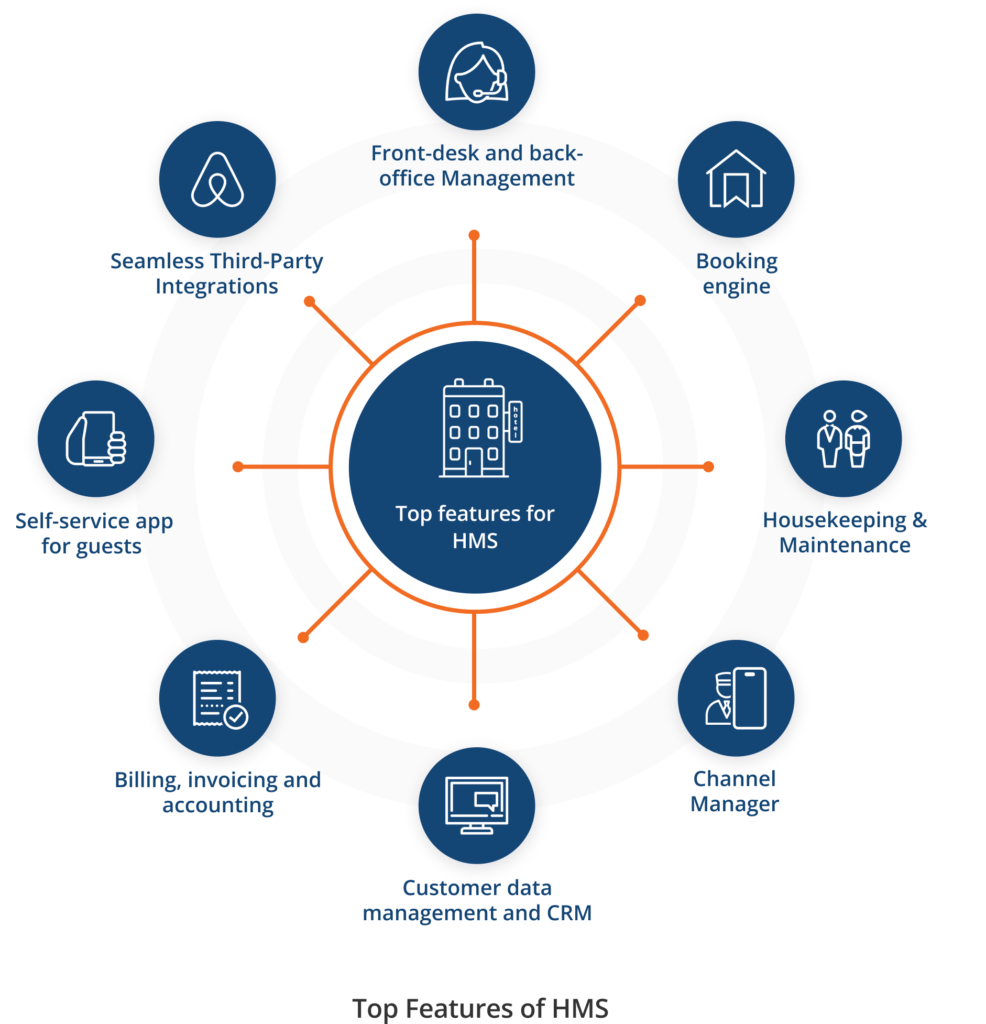
Top Features of an HMS
Hoteliers face the challenge of providing a personalized experience for every guest, as well as running the business efficiently. The introduction of a hotel management system to your business will help to achieve all of these points.
But when you decide to implement an HMS, the big question is what features it should have. It is obvious that software should have a user-friendly interface. However, some other features are not so apparent to those who want to optimize their businesses. Therefore, let’s explore the top functions of effective hotel management software.
1. Housekeeping and maintenance
This feature helps to assign various duties to housekeepers, manage room statuses, and organize staff’s work efficiently.
For instance, a front-office manager can create a list of necessary tasks for housekeepers, and update the room information immediately. Also, customized hotel management software development may include an application for staff, allowing housekeepers to communicate with front-office personnel in real-time mode.
An HMS enables employees to manage operations effectively and instantly conduct all customer requests without the need to contact other departments either by phone or email.
Another not less important function of an HMS is maintenance management. Through an HMS, you can manage maintenance by recording all failures and repairs.
Every member of the hotel team should have access to a list of assignments, work instructions, and other information from a smartphone, laptop, or another device. With a work process built in this manner, each team member knows precisely what to do, when, where, and how.
2. Billing, Invoicing, and Accounting
Billing and invoicing, cashiering, and currency exchange can be challenging tasks that consume a lot of time. For this reason, hotel management software should be created to simplify these processes and make staff activities more efficient.
For example, guest payments can be managed, edited, and invoices can be generated and sent automatically. Invoicing for services and add-ons can also be easily managed.
Using custom-developed HMS, you can connect accounting with other departments (f.e. front office, procurement, etc.) and operations in the hotel – so it helps automate all financial data entry. Such a solution helps to optimize data accounting and reduce time-consuming processing work.
3. Booking Engine
The decision of a guest to book a room in your hotel is influenced by numerous factors. One of them is the presence of a booking engine and its performance. The best result can be achieved if this engine is perfectly compatible with an HMS.
The online booking mechanism is like a guide for hotel guests. With just one click, they receive information about a room, its availability and cost, breakfast and lunch options, and additional amenities.
At the same time, the sooner a reservation is confirmed, the less likely a client will choose another hotel.
A booking engine is an excellent process optimization tool, as it can replace several employees at once. You won’t have to rapidly reply to letters and calls anymore because an engine will do everything for you in seconds.
4. Front-desk and Back-office Management
The business is more than just planning and investments but, firstly, people. An effective hotel management system helps all employees to successfully administer a hotel and serve clients.
Thanks to an HMS, front-desk workers get an opportunity to control reservations, rates, and room availability. Thus, they can add or change a reservation, make changes to room descriptions, and extend guests’ stay with one click.
An HMS can also offer many features for back-office management, here are some of them:
Management of conferencing and events. This function is directly related to the planning and holding of different meetings or events.
Inventory Management. This feature includes all processes related to the control of assets and products, for example, ordering, storage, and distribution.
Human resources management. An HMS can centralize and optimize all processes related to hiring, training, or outboarding employees, as well as personnel data management.
Marketing. You can manage, launch and analyze successful marketing campaigns directly from an HMS.
5. Channel Manager
Channel manager is an essential and reliable tool that will make your hotel visible on any booking platform. In addition, a channel manager will help you keep up-to-date information about rooms, prices, and availability on these platforms. With this feature, you won’t have to worry about unpleasant situations when one room is booked by several people or inaccurate prices.
Thanks to hotel management software, you can easily incorporate a channel manager into your business, and manage an unlimited number of distribution channels. As a result, you will be able to get more bookings from different platforms, which means you will boost your income.
6. Customer Data Management and CRM
Most hotel management systems have CRM modules that help to collect and manage customers’ data. Thanks to the implementation of CRM, all the necessary personal and contact information about your guests will be in front of you. Also, you can add information about new guests to the system or edit the profiles of regular customers.
With the help of an HMS with a CRM module, you can:
send personalized emails and offers to customers;
run a customer loyalty or membership program;
send documents for registration or invoices to customers by email;
see service ratings and reviews from each guest;
reduce queues during check-ins, because all customer data is already in your database;
leave information for hotel staff, etc.
Using hotel management software with CRM will help you better understand your guests, their behavior, and their preferences.
Thanks to this, you will be able to provide guests with VIP service and get more bookings, positive reviews, and recommendations for your hotel. Also, it will increase the chances that customers will return to your hotel again in the future.
7. Seamless Third-party Integration
Hotel software should be open to third-party applications and services if you want to attract more customers. Integrated applications can be responsible for various aspects, including booking, marketing, data analysis, and so on.
For example, thanks to integration with online travel agencies, hospitality businesses can reach a wide audience of potential clients. Hotel managers can effortlessly modify room details and pricing on various booking platforms in this scenario.
Hotels can also benefit from integration with third-party guest engagement platforms providing the possibility to find all the information about the hotel, order food, call a maid, etc. using a smartphone.
8. Self-Service App for Guests
Nowadays, customer-oriented hotels are doing everything possible to ensure that their guests have the most personalized and wonderful vacation. One feature that makes it possible is a self-service app.
Thanks to such applications, guests can independently and remotely pay for their stay, order food, or some kind of service to their rooms. In addition, applications for guests provide the possibility of mobile check-in and check-out.
With an HMS, you can implement a guest self-service app and create a better customer experience.
Process and Cost of the HMS Development in 2025
After you learned all the information about an HMS and its functions, you have decided to order the development of the customized software for your hotel.
But what’s next? Let’s look at the stages of the development of software.
Foremost, you need to choose a company that will develop the custom software solution for you. For example, you can find and contact outsourcing companies. You can learn more about the benefits of hiring an outsourcing company here.
When you have already chosen tech specialists with the needed expertise, you need to present your idea to them. After that, the process of bringing your idea to life will begin.
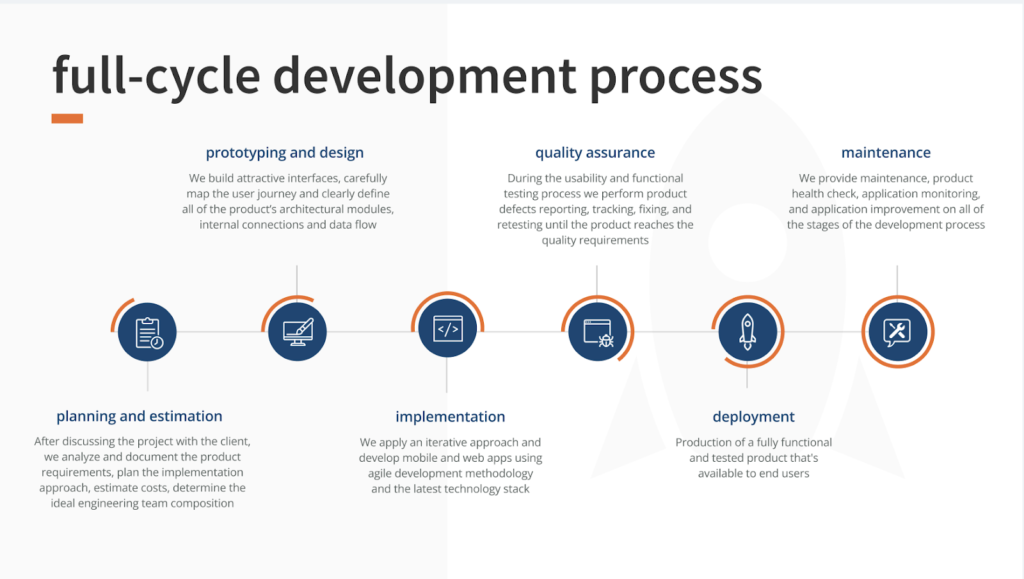
The hotel management software development process includes:
Planning and estimation. Together, we form a concept with all the necessary features according to your business-specific needs. Then we plan data security, easy changeability, and scalability of the product, and choose the most cost-effective development approach.
Prototyping and design.Our IT specialists build a basic prototype of your future software based on the developed user journey map – client-oriented design, attractive interfaces, etc. We clearly define the product’s architecture, third-party integrations, and secure data processing.
Implementation. Tech specialists develop mobile and web applications using Agile development methodology and the latest technology stack.
Quality assurance. The purpose of this process is to perform product defects reporting, tracking, fixing, and retesting until the product reaches the quality requirements.
Deployment. Delivery of a fully functional and tested product that is available to end users.
Maintenance. Specialists provide the product’s health check, application monitoring, as well as application customization according to the needs and feedback from real users – your employees and guests.
What about the costs of custom hotel management software development?
The cost of developing each project is different. If we are talking about software development for hotel management, the cost will depend on the number of functions and their complexity.
The approximate average cost of custom hotel management software development can vary from $30,000 to $80,000 and more (depending on the product complexity). This price is possible if you cooperate with developers from Eastern Europe. The development cost can be 2-3 times higher if you choose specialists from the USA, Canada, or Western Europe.
Many processes, such as project management, integration of third-party applications, and design can be priced separately. It also has an impact on the cost of the development.
Hotel Management Software Development with ImproveIT Solutions
In conclusion, it’s worth saying that building and developing a business is like a puzzle. A successful hotel business requires excellent customer service, attention to details, and a focus on creating a welcoming and hospitable environment for guests. We can help you with one of the pieces of the puzzle – effective software.
ImproveIT Solutions is a software developmentcompanybased in Ukraine. Our team has brought to life many ideas, including projects such as software for hotels. Therefore, we have relevant experience and expertise in this matter.
We are working with hospitality projects and have a deep understanding of this industry’s needs. Our developers constantly create and implement different features for the specific HMSs. Developing a booking engine, a channel manager, or a reservation system is common practice for us. Check our case studies here.
We will not only help to form a concept with all necessary features according to your business-specific needs but also provide the most cost-effective approach to the development process. Your software will be planned and realized carefully – from a client-oriented intuitive design, and secure data processing, to the possibility of easy scaling according to your growth.
Our solutions enable hospitality businesses of all sizes to enhance their productivity and simplify their operations. Feel free to contact our specialists to discuss your product and get a detailed project analysis and quote.
ImproveIT Solutions est une société informatique qui fournit des services experts d’ingénierie logicielle et des solutions de développement de logiciels dédiés par des équipes. Le portfolio de la société comprend des solutions logicielles allant de simples applications mobiles aux systèmes fintech d’entreprise utilisés dans 75 pays. Leur domaine est le développement SaaS mobile et web, principalement pour les marchés français, suisse, néerlandais, allemand et américain. L’équipe a des partenaires de gestion avec une expérience combinée de plus de 15 ans dans la gestion informatique, la création de produits logiciels, la mise à l’échelle des activités et la sélection du personnel technique en Ukraine et dans l’UE.
Vitaliy raconte comment l’entreprise a été créée grâce à son amitié professionnelle avec Taras Chornyi, cofondateur d’ImproveIT Solutions. Travaillant ensemble dans la même branche, ils ont acquis une expérience approfondie dans le développement, la gestion et les opérations de logiciels. Dans ce domaine, ils ont acquis une solide compréhension de la façon dont les services sont rendus à un excellent niveau.
De plus, ils ont observé certaines imperfections du marché existant et ont voulu combler cette lacune et se sont souciés de créer une entreprise avec un ensemble de valeurs particulières telles que la transparence et l’excellence au travail.
Si l’équipe interne du client manque d’expertise, ImproveIT Solutions intervient pour combler les lacunes et fournit des conseils stratégiques pour le développement de produits et la feuille de route. La société met à disposition des développeurs et agit en tant que partenaire technique qui essaie toujours d’avoir une vue d’ensemble de ce qu’ils construisent. Ils fournissent également des conseils techniques avec des suggestions et des points d’amélioration. De plus, l’équipe reste flexible pour discuter des termes et conditions, du modèle d’engagement, de la taille des projets et de la capacité à fournir presque toutes les technologies présentes sur le marché.
La société dispose d’une équipe de développeurs professionnels experts avec des années d’expérience dans le développement et la conception de solutions logicielles exclusives sur mesure pour des clients du monde entier. Le groupe fournit des services à des clients allant des startups récemment créées à une entreprise bien établie qui a besoin de mettre à niveau son logiciel en fonction de l’évolution des besoins du marché. Ses produits logiciels innovants et attrayants améliorent les taux d’activité des clients et apportent les solutions rapides de leurs problèmes commerciaux.
Avec une vaste connaissance et expertise du domaine, la société répond aux besoins de développement de logiciels de ses précieux clients. Les solutions logicielles développées par l’équipe sont adaptées à des problèmes commerciaux spécifiques et sont faciles à utiliser pour les petites et moyennes entreprises. L’équipe expérimentée de développeurs multidisciplinaires s’appuie sur les dernières tendances et technologies pour fournir des solutions utilisables et maintenables. L’équipe d’ImproveIT Solutions garde à l’esprit les exigences du client et les besoins du marché et développe un produit qui répond à ces deux critères. Cela encourage le client à sélectionner ImproveIT Solutions comme premier choix de partenaire de développement. Ainsi, pour ces services remarquables, la société est classée parmi les meilleures sociétés de développement de logiciels en Ukraine chez GoodFirms.
Pour offrir aux utilisateurs finaux une expérience enrichissante, ImproveIT Solutions fournit de nouvelles technologies disponibles sur le marché qui répondent simultanément aux besoins de leurs clients et du marché. Ils augmentent la présence en ligne de leurs clients grâce à leurs approches uniques et innovantes. Leurs solutions Web spécifiques à la branche d’activité offrent une position de pointe à leurs clients pour se démarquer des autres concurrents sur le marché.
A Client reviews the services of the company in web development.
Ces fantastiques services de développement Web de l’équipe sont la raison pour laquelle la société se classera bientôt parmi les meilleures sociétés de développement Web en Ukraine chez GoodFirms.
Interrogé sur les futurs objectifs de l’entreprise, Vitaliy mentionne qu’ils prévoient plutôt une croissance interne qu’une croissance externe. L’équipe continuera à mettre en œuvre et à ajuster ses processus internes pour une croissance progressive et les meilleures pratiques commerciales occidentales. C’est plus important pour eux que la simple croissance des revenus ou des effectifs. Avec de bonnes stratégies et pratiques commerciales vient le succès, et avec le succès vient la croissance interne. Ainsi, au cours des 10 prochaines années, ils prévoient de se développer largement sur les marchés de la haute technologie de l’UE et des États-Unis et continueront de rester à la pointe des technologies les plus récentes et les plus populaires.
C’était l’extrait de l’interview de Vitaliy. Si vous le souhaitez, vous pouvez également parcourir l’interview détaillée chez GoodFirms.
À propos de GoodFirms
GoodFirms, basée à Washington, D.C., est une société innovante de recherche et d’évaluation B2B qui parcourt largement le marché pour trouver des agences de services aux entreprises parmi de nombreuses autres entreprises technologiques qui offrent les meilleurs services à leurs clients. Le processus de recherche approfondi de GoodFirms classe les entreprises, améliore leur réputation en ligne et aide les demandeurs de services à choisir le bon partenaire technologique qui répond à leurs besoins commerciaux.
A propos de l’auteur
En tant que rédactrice de contenu chez GoodFirms, Anna Stark comble le fossé entre les demandeurs de services et les fournisseurs de services. Le rôle dominant d’Anna est de comprendre les réalisations et les attributs critiques de l’entreprise et de les mettre en mots. Elle croit fermement au charme des mots et mise sur de nouvelles approches qui fonctionnent, y compris de nouveaux concepts qui renforcent l’identité de l’entreprise.
envoyez votre demande et
obtenez un aperçu des coûts